
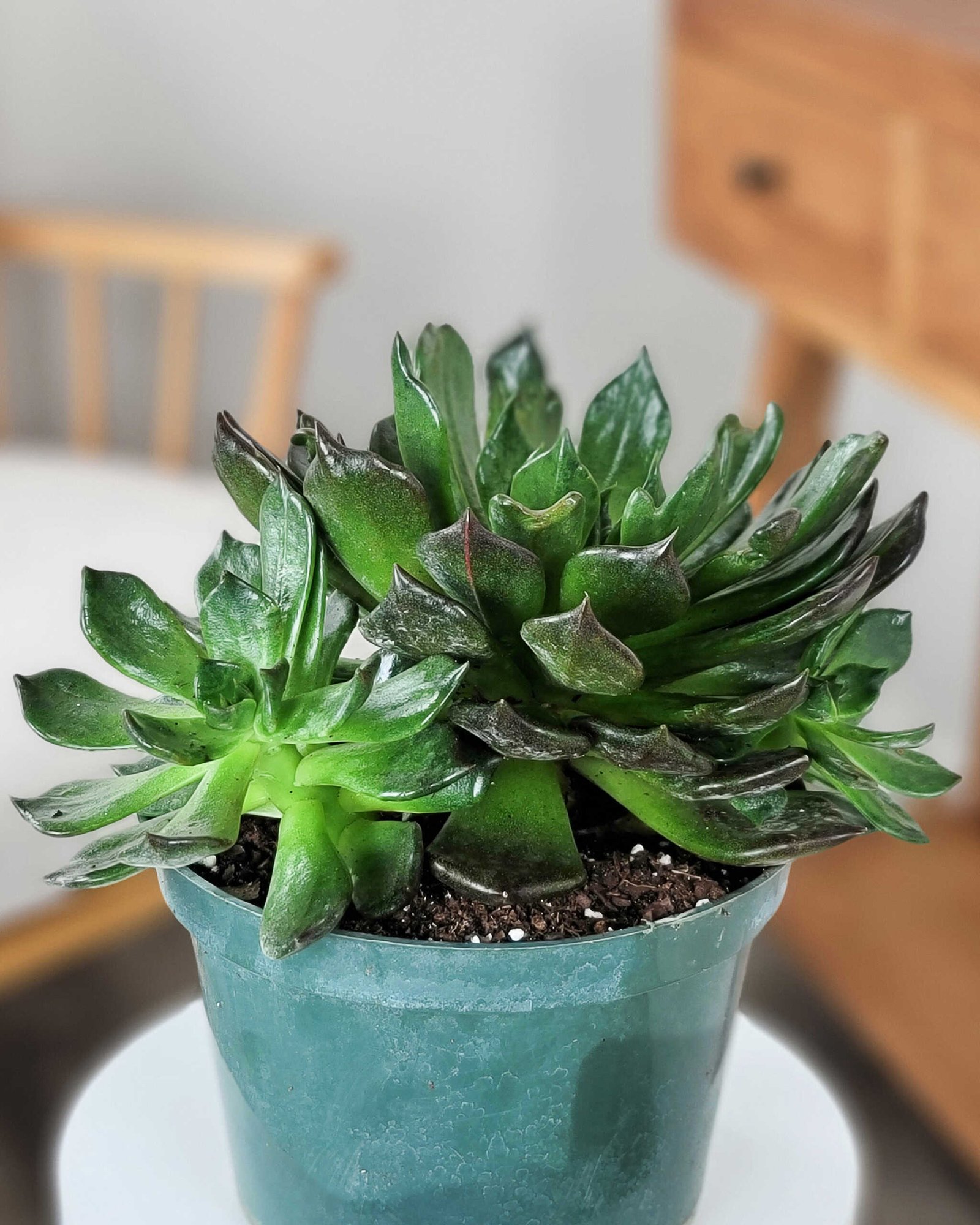
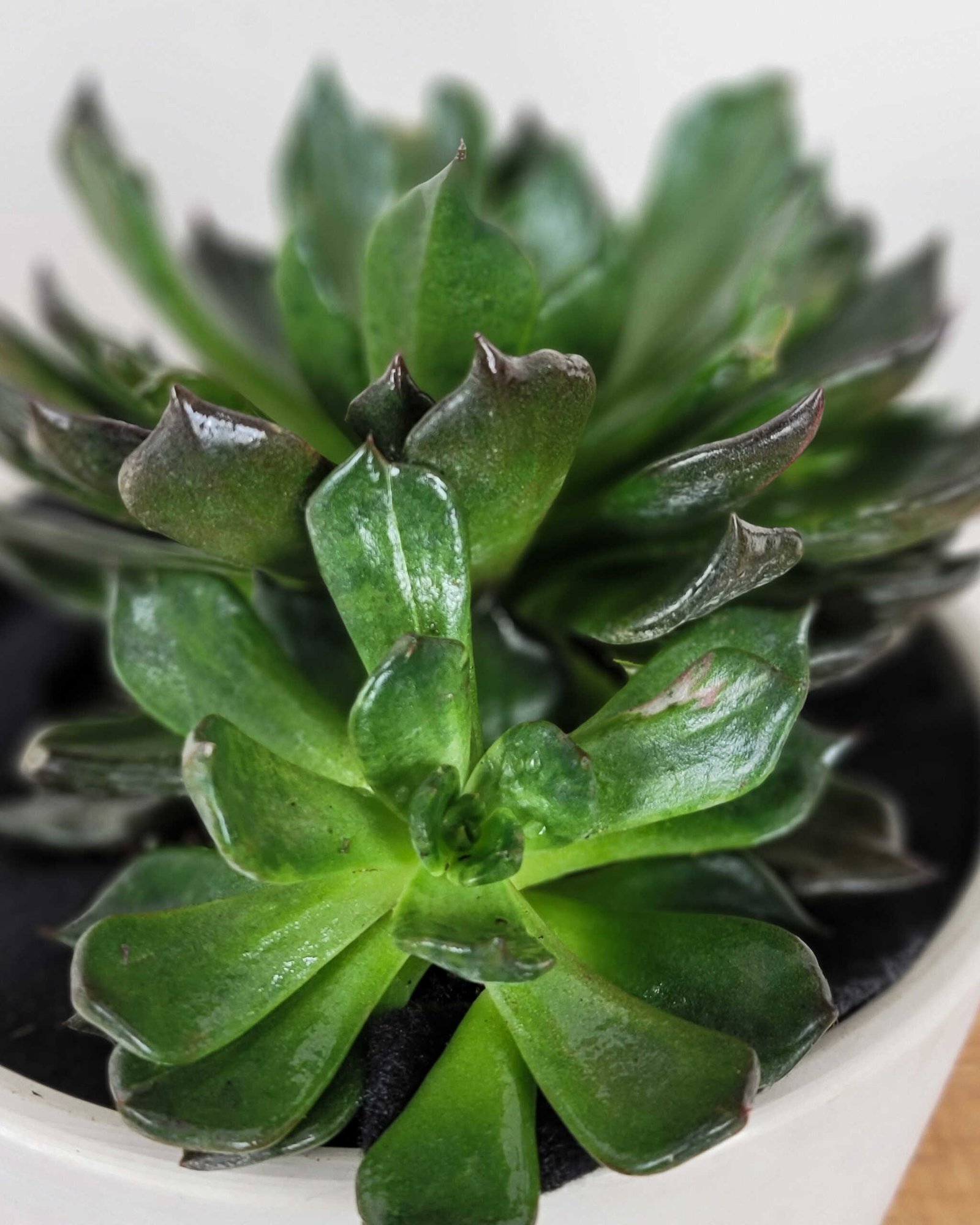
Black Prince Echeveria
$34.00
Scientific Name: Echeveria affinis ‘Black Prince’
Common Names: Black Prince Echeveria
Overview: Echeveria ‘Black Prince’ is a stunning succulent that captivates with its dramatic, dark-hued rosettes. Each leaf, starting as a deep green, matures to a rich, almost black shade, creating a striking contrast in any plant collection. The compact rosettes can grow up to 3 inches wide, and during late fall, this eye-catching plant produces bright red flowers that add an extra layer of beauty.
Native to Mexico, ‘Black Prince’ thrives in bright, indirect light and well-draining soil. It is drought-tolerant and requires minimal watering, making it an excellent choice for busy gardeners or those new to succulents. Ideal for containers, rock gardens, or as a unique indoor accent, this Echeveria is as resilient as it is visually striking.
Caring for Your Echeveria
Echeveria is a popular genus of succulent plants known for its beautiful rosette shape and soft, pastel-like colors. Native to semi-desert regions of Mexico and Central America, these plants are naturally adapted to dry climates.
Because their thick leaves store water, Echeveria plants are drought-tolerant and relatively easy to care for. With proper light, drainage, and moderate watering, they can thrive indoors or outdoors.
Light Requirements
Echeveria needs plenty of light to maintain its compact shape and vibrant color.
For best results:
-
Provide at least 6 hours of bright light daily
-
Indoors: Place near a south- or east-facing window
-
Outdoors: Full sun is fine, but protect from intense afternoon heat in very hot climates
If the plant becomes stretched, pale, or “leggy,” it is likely not receiving enough light.
Rotating the pot occasionally helps promote even growth.
Soil and Drainage
Proper drainage is essential for healthy roots.
Use:
-
A cactus or succulent potting mix
or -
Regular potting soil mixed with coarse sand or perlite
The soil should dry quickly and not retain excess moisture.
A slightly acidic to neutral pH (around 6.0–7.0) works well.
Always plant in containers with drainage holes to prevent root rot.
Watering Guide
Echeveria prefers a “soak and dry” method.
This means:
-
Water thoroughly
-
Allow excess water to drain
-
Let soil dry completely before watering again
During spring and summer (active growth), watering may be needed every 1–2 weeks depending on climate.
During fall and winter (dormancy), reduce watering significantly.
Overwatering is the most common cause of failure. Soft, mushy leaves usually indicate excess moisture.
Avoid pouring water directly into the center rosette, as trapped moisture can cause rot.
Fertilizing
Echeveria is not a heavy feeder.
During the growing season:
-
Use a balanced fertilizer (such as 10-10-10)
-
Dilute to half strength
-
Apply once a month
A slow-release fertilizer at the beginning of spring is also effective.
Avoid fertilizing during fall and winter when the plant is not actively growing.
Too much fertilizer can cause weak, stretched growth.
Pruning and Maintenance
Echeveria requires very little pruning.
Maintenance includes:
-
Removing dried or damaged lower leaves
-
Cleaning fallen debris from the soil surface
If a plant becomes leggy:
-
Cut the rosette from the stem
-
Allow the cut end to callus
-
Replant in fresh, well-draining soil
This helps restore a compact shape.
Always use clean, sterilized tools when trimming.
Pest and Disease Control
Echeveria is generally resistant but may occasionally attract:
-
Mealybugs
-
Aphids
-
Spider mites
Inspect your plant regularly.
If pests appear:
-
Use insecticidal soap
-
Apply neem oil
-
Improve air circulation
Most disease problems are related to excess moisture.
To prevent fungal issues:
-
Ensure good drainage
-
Avoid high humidity
-
Do not let water sit on leaves
Healthy Echeveria leaves should feel firm and look evenly colored.
Expert Growing Tips
For long-term success:
-
Provide strong light year-round
-
Avoid sudden temperature drops
-
Keep in temperatures between 60–80°F (16–27°C)
-
Do not overcrowd plants
When properly cared for, Echeveria produces offsets (small “pups”) that can be separated and replanted.
| Pot Size | Medium |
|---|
Related products
Cactus and Succulents
Cactus and Succulents
Cactus and Succulents
Cactus and Succulents
Cactus and Succulents
Best Sellers
Cactus and Succulents
Cactus and Succulents